Instruct-ERIC
Instruct-ERIC
Instruct-ERIC (Integrated Structural Biology Infrastructure) is European research infrastructure, granting access to scientists from member countries to necessary equipment, technologies and expertise in structural biology.
Instruct-ERIC also organizes courses and workshops in structural biology methods and technologies, supports internships in Instruct-ERIC centres, grants pilot-projects for young researchers, organizes scientific conferences and acts as a joint hub for structural biologists in Europe.
At the moment there are 13 countries and 9 Centres in Instruct-ERIC. Instruct-ERIC Centres organize and support access to national structural biology infrastructure and take part in other Instruct-ERIC activities.
Latvian national contact point and its organizations
At the moment in Latvia there are two organizations in which significant research in structural biology field are carried out – Latvian Biomedical Research and Study Centre (LBMC) and Latvian Institute of Organic Synthesis (LIOS).
Short description of LBMC structural biology group:
- Published papers in SCOPUS during last 5 years – 48
- Main areas of research:
- Structural investigations of ssRNA phages and applications of their virus-like particles in vaccine development
- Structural investigations of Borrelia surface proteins
- Structural investigations of pharmacologically relevant proteins:
- Structural investigations of enzymes and their microcompartments, involved in trimethylamine metabolism
- Structural investigations of carbonic anhydrases
Short description of NMR group of LIOS:
- Published papers in SCOPUS during last 5 years – 24
- Main areas of research:
- Structural investigations of protein interactions with LIOS drug candidates
- Development of ssNMR technology
- Structural investigations of spider silk proteins
- Structural investigations of amyloid fibers
National infrastructure
Infrastructure at LBMC:
- Standard equipment for cloning (PCR machines, centrifuges, electrophoresis units, etc)
- Equipment for protein production in bacterial, yeast and insect cell cultures (incubators, sterile rooms, laminars, cold rooms, small scale fermenter)
- Equipment for protein purification (chromatoghraphy systems like Akta Explorer, Akta FPLC, Akta prime, ultracentrifuges, etc)
- Bruker Daltonics MALDI-TOF mass spectrometer
- Equipment for protein crystallization – thermoregulated crystallization room and incubators, TECAN Freedom Evo crystallization robot, microscopes, accessories for cryocrystallography
- In-house protein crystal diffraction system Bruker X8 Proteum with Microstar x-ray generator and CCD detector
Infrastructure at LIOS:
- Standard equipment for cloning (PCR machines, centrifuges, electrophoresis units, etc)
- Equipment for protein production in bacterial, yeast and insect cell cultures (incubators, sterile rooms, laminars, cold rooms, small scale fermenter)
- Equipment for protein purification (chromatoghraphy systems like Akta Explorer, Akta FPLC, Akta prime, ultracentrifuges, etc)
- Bruker Daltonics MALDI-TOF mass spectrometer
- Equipment for protein crystallization – thermoregulated crystallization room and incubators, TECAN Freedom Evo crystallization robot, microscopes, accessories for cryocrystallography
- In-house protein crystal diffraction system Bruker X8 Proteum with Microstar x-ray generator and CCD detector
Latvian contact point (contact person)
Prof. Kaspars Tārs
kaspars@biomed.lu.lv
INSTRUCT-ERIC TRAININGS AND WORKSHOPS
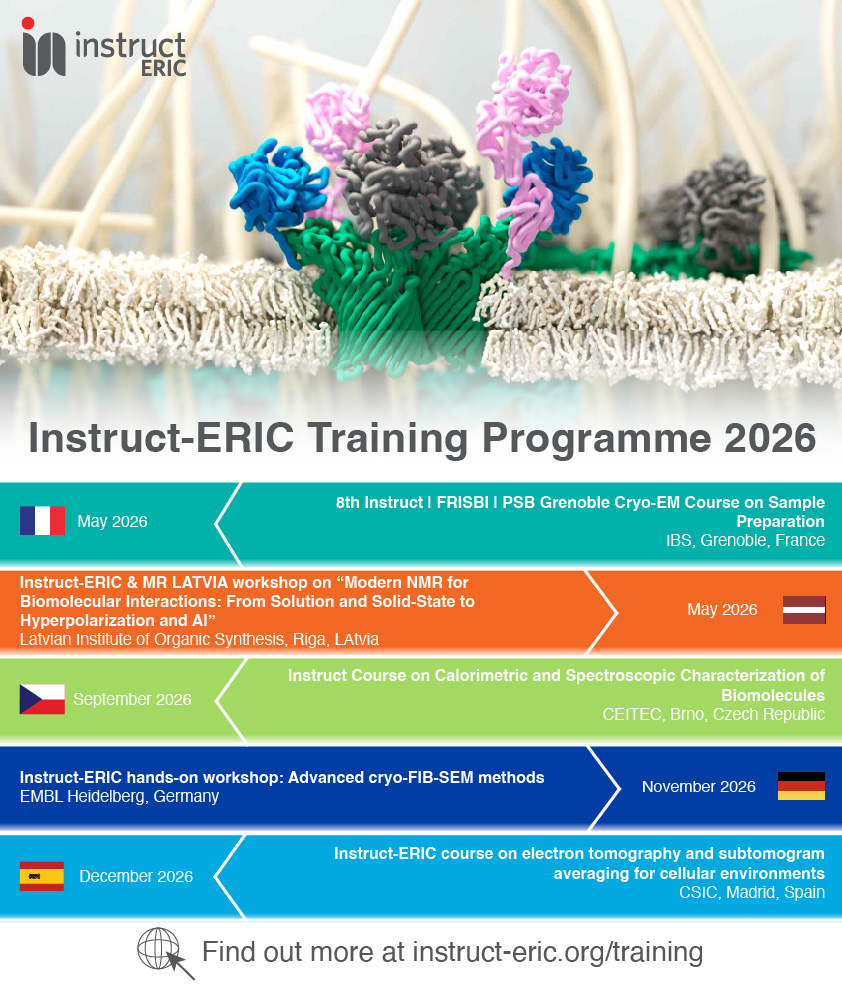
Registration to the Instruct-ERIC course and MR Latvia workshop “Modern NMR for Biomolecular Interactions: From Solution and Solid-State to Hyperpolarization and AI”
The course is being organized by the Latvian Institute of Organic Synthesis – part of the Instruct-ERIC research infrastructure – in collaboration with CNRS/CRMN (Lyon, France) and CERM/CIRMMP (Florence, Italy. Time: June 8-11, 2026 (4 days) Venue: Latvian Institute of Organic Synthesis, Aizkraukles 21, LV-1006, Riga, Latvia
Target group: PhDs, Postdocs and ESRs.
Deadline for applications: April 28, 2026
This course aims to provide young researchers with a comprehensive understanding of how modern NMR spectroscopy methods can reveal the complexity of biomolecular interactions. In the theoretical part of the course, state-of-the-art biomolecule interaction NMR techniques in liquids and solids, hyperpolarization, and AI will be discussed. The hands-on sessions on NMR spectrometers will focus on probing protein-ligand interactions using 1D and 2D NMR spectra in liquids, as well as microcrystalline samples in solid-state NMR. The course tutors will demonstrate how to analyze and plot the acquired datasets to visualize protein-ligand interaction sites.
There will be limited possibilities to bring own unlabeled samples for preliminary characterization, including interactions with ligands (e.g. 1D liquid-state NMR). Bringing of own samples should be negotiated individually before course.
The number of participants for the hands-on section is limited to 12. They will be selected based on filled application.
The registration is free of charge. The travelling (within Europe) expenses partially are also compensated by the course organizers (up to 100 EUR based on location). Successful candidates will be notified by 30 April at the latest.
The course is organized in collaboration with the H2020 “Magnetic resonance development in Latvia project team (MR LATVIA)”. At the moment, the accepted tutors for the course are:
- Harald Schwalbe – Goethe University, Frankfurt, Germany
- Guido Pintacuda – CNRS/CRMN, Lyon, France
- Roberta Pierattelli – CERM/CIRMMP, Florence, Italy.
- Anne Schutz – Ludwig-Maximilians-Universität München, Germany
- Julien Orts – University of Vienna, Austria.
- Dennis Kurzbach – University of Vienna, Austria.
- Alons Lends – LIOS, Latvia
- Kaspars Tars – LBMC, Latvia
For registration and more information, please visit the course web page.
For any inquiries, please write to natalja.jarohnovica@osi.lv and alons.lends@osi.lv