

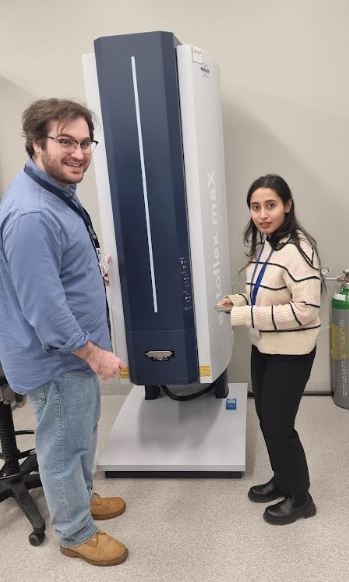
Alessio Perazzoli and Shapla Bhattacharya at work with a MALDI-TOF mass spectrometer
One of the key factors that significantly contributes to attracting international PhD students is the availability of world-class research infrastructure. Latvia is a member state of the European structural biology infrastructure consortium Instruct-ERIC, with its own research site, Instruct-LV, whose current member organisations are BMC and OSI. Structural biologists at OSI are well equipped, with access to NMR spectrometers as well as a wide range of instruments for protein production, purification, and the characterization of molecular interactions. As an Instruct-ERIC member state, Latvia also has access to instruments located in other consortium countries, such as synchrotrons and cryo-EM facilities.
Two of the international PhD students working in the field of structural biology are Shapla Bhattacharya from India and Alessio Perazzoli from Italy. Both are affiliated with the laboratory of leading researcher Emilio Parisini at OSI and are nearing the completion of their doctoral studies. Shapla and Alessio work in the field of enzyme engineering and have achieved significant results, including improvements to PETase. PETase is an enzyme capable of degrading PET plastic bottles and other products, which has attracted considerable interest from the perspective of environmentally friendly waste recycling.
The Latvian Biomedical Research and Study Centre is implementing project No. 1.1.1.5/3/24/I/006 “Development of Latvia’s research potential by strengthening the integration of the Latvian Biomedical Research and Study Centre into European infrastructures and scientific networks” within which the Latvian National Partnership Plan for the Integrated Structural Biology Infrastructure (Instruct-ERIC) is being implemented.